Between the boardroom declaration that "AI will transform our business" and actual deployed automation lies a chasm that swallows most initiatives. The gap is not a technology problem. It is a planning problem.
Organizations that succeed follow a structured pipeline that converts messy organizational knowledge into precise implementation specifications. They start with their own people and processes, not a vendor demo.
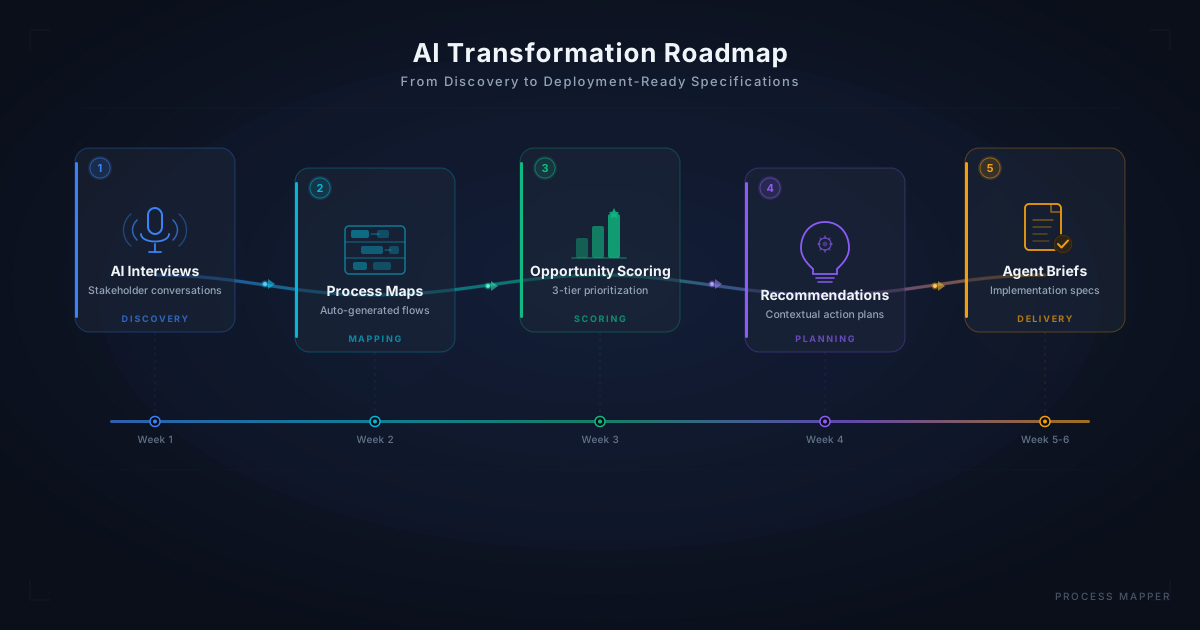
This guide walks through the five-phase pipeline that takes you from "we should use AI" to "here is exactly what to build, in what order, and why."
Phase 1: Discovery — Structured AI Interviews and Organizational Context
Setting Up AI-Guided Interviews
Traditional process discovery relies on consultants conducting hours of interviews, then manually synthesizing notes. AI-guided interviews accelerate this by structuring the conversation around the right axes.
Each session should focus on a single business function. The interviewer walks the stakeholder through:
- Process steps: What happens, in what order, and who does it
- Decision points: Where do people exercise judgment, and what information do they use
- Exceptions: What goes wrong, how often, and what is the recovery process
- Tool landscape: What systems are involved, and where does manual data transfer happen
- Volume and frequency: How often does this run, and what is the throughput
- Pain points: Where do bottlenecks, errors, and frustration concentrate
A well-structured AI interview produces tagged, categorized data that maps directly to downstream analysis phases.
Choosing the Right Stakeholders
You need three perspectives for each function:
- The practitioner who does the work daily and understands the real process (not the documented one)
- The manager who understands volume, exceptions, and business impact
- The systems owner who knows the technical landscape and integration constraints
Interviewing only managers produces aspirational process maps. Interviewing only practitioners misses strategic context. You need both.
Organizational Context Documents
Before interviews begin, upload organizational context documents: org charts, existing process documentation, system architecture diagrams, compliance requirements, and strategic plans. This grounds the AI analysis in your specific organizational reality rather than producing generic recommendations. It also establishes the vocabulary of your organization, so when a stakeholder says "we run it through the approval matrix," the system already knows what that means.
Phase 2: Process Mapping — From Transcripts to Swimlane Diagrams
Raw transcripts are valuable but not actionable. Phase 2 transforms qualitative conversation data into structured, visual process maps.
How AI Converts Interviews into Process Maps
The AI engine parses transcripts and extracts:
- Actors: People, teams, and systems that participate
- Activities: Discrete steps each actor performs
- Sequences: Order of activities, including parallel paths
- Handoffs: Points where work transfers between actors
- Data flows: Information moving between steps, including format and medium
- Decision gates: Conditional branches based on rules or judgment
These elements become swimlane process maps — structured data objects that feed directly into the scoring phase.
Understanding the Output
A good process map reveals what documentation never captures: the shadow processes. The workarounds, the "just email it to Sarah" steps, the spreadsheets bridging gaps between enterprise systems. Shadow processes are where the highest-value automation opportunities hide, because they represent manual effort that exists solely due to system limitations.
Review each map with the original stakeholders. The AI may have inferred incorrect sequences or missed conditional paths. A 30-minute review catches errors that would propagate through the entire pipeline.
Phase 3: Opportunity Scoring — Prioritizing with a 3-Tier Framework
Not every process should be automated, and not every opportunity should be pursued first.
The Three Scoring Dimensions
Complexity measures how difficult the automation will be to build. Factors include systems involved, data format variety, unstructured data prevalence, exception paths, and degree of human judgment required. Lower scores mean easier implementation.
Impact measures business value. Factors include time saved per execution, frequency, error rate reduction, compliance improvement, and customer experience gains. Higher scores mean greater value.
Feasibility measures organizational readiness. Factors include data availability, API maturity, stakeholder willingness, regulatory constraints, and existence of clear success metrics. Higher scores mean fewer barriers.
Which Processes to Prioritize
Start with processes scoring low complexity, high impact, and high feasibility. These are your quick wins: automations that deploy fast, deliver measurable value, and face minimal resistance.
Resist tackling the highest-impact opportunity first if it carries high complexity. Early failures create organizational antibodies that make every subsequent initiative harder. Build credibility with quick wins first.
Also identify automation traps early: processes where complexity is extreme, feasibility is low, and impact is moderate. Remove them from consideration.
Phase 4: Recommendations — Specific, Contextual, Actionable
Generic consulting advice like "consider implementing RPA for your invoice processing workflow" contains zero actionable information. AI-generated recommendations are different because they are grounded in your specific process data.
What AI Recommendations Look Like
Each recommendation ties to a scored opportunity and includes:
- The specific process steps to automate, referenced by position in the process map
- The suggested approach: rule-based, AI-assisted, fully autonomous, or human-in-the-loop hybrid
- The integration points: systems, APIs, and data transformations required
- The expected outcome: quantified time savings, error reduction, and throughput improvement
- The prerequisites: data cleanup, API access, stakeholder training needed first
- The risk factors: what could go wrong and mitigation strategies
The difference from generic advice is specificity. "Automate the three-way match in accounts payable by connecting your ERP purchase order API to the invoice OCR pipeline, with a human review queue for discrepancies exceeding $5,000" -- an engineering team can scope that. A CFO can model the ROI. Every recommendation carries a chain of evidence back to the original stakeholder conversations.
Phase 5: Agent Briefs — Deployment-Ready Specifications
The final phase transforms recommendations into agent briefs: specification documents that an engineering team can use to build and deploy AI agents.
What an Agent Brief Contains
An agent brief is more specific and more technical than a product requirements document, while remaining accessible to non-engineers. Each brief includes:
- Agent identity and scope: What this agent does, what it does not do, and its authority boundaries
- Capabilities: Specific actions expressed as input-output pairs with examples
- Integration specifications: Systems, authentication methods, API endpoints, and data schemas
- Decision logic: Rules, confidence thresholds, and escalation criteria
- Human-in-the-loop touchpoints: Where a human reviews, approves, or overrides
- Error handling: Behavior for malformed inputs, unavailable systems, and edge cases
- Success metrics: Quantitative measures of expected performance
- Implementation timeline: Phased rollout with milestones and validation checkpoints
Handing Off to Engineering
Agent briefs are self-contained. An engineering team can begin implementation without re-interviewing stakeholders. The handoff conversation should focus on: technical feasibility validation, resource estimation, and dependency identification.
Putting It All Together
The end-to-end pipeline typically runs on a six-week timeline:
- Week 1-2: Discovery. Conduct interviews, upload context documents, validate transcripts.
- Week 2-3: Process mapping. Generate maps, review with stakeholders, iterate.
- Week 3-4: Scoring. Run the three-tier framework, build the priority matrix, select the first wave.
- Week 4-5: Recommendations. Generate detailed recommendations, review with leadership.
- Week 5-6: Agent briefs. Produce deployment-ready specs, hand off to engineering.
For organizations mapping multiple functions, phases can run in parallel. The critical success factor is validation at every stage -- skipping it creates compounding errors that surface during implementation, when they are most expensive to fix.
Common Pitfalls
Trying to Automate Everything at Once
The most common failure mode is scope explosion. Engineering bandwidth and organizational change capacity are finite. Start with three to five high-confidence opportunities, deliver results, then expand.
Ignoring Change Management
Automation changes jobs. Even when it eliminates tedious work, it creates anxiety. Every agent brief should include a change management section: who is affected, how their role changes, and what training they need.
Not Validating with Stakeholders
The AI pipeline is powerful but not omniscient. Every phase needs a validation loop with the humans who do the work. A 30-minute validation session costs far less than a failed deployment.
Optimizing for Technology Instead of Outcomes
It does not matter which model your agent uses. What matters is whether it reduces invoice processing time from 12 minutes to 45 seconds. Anchor on business outcomes and let engineering make technology choices.
Start Building Your Roadmap
The gap between AI aspiration and implementation is a methodology gap. Organizations that follow a structured pipeline -- discovery, mapping, scoring, recommendations, agent briefs -- convert organizational knowledge into deployable automation with predictable timelines and measurable outcomes.
Start with one business function. Interview the people who do the work. Map what you find. Score the opportunities. Generate data-grounded recommendations. Produce agent briefs engineering can build from. Then do it again.