Every enterprise has processes that look nothing like the documentation says they should. Between the last audit and today, workarounds were invented, handoffs were rerouted, and institutional knowledge settled into the minds of individual employees rather than into any system of record. When leadership finally decides it is time to understand how work actually gets done, they commission a process audit. And that is where the pain begins.
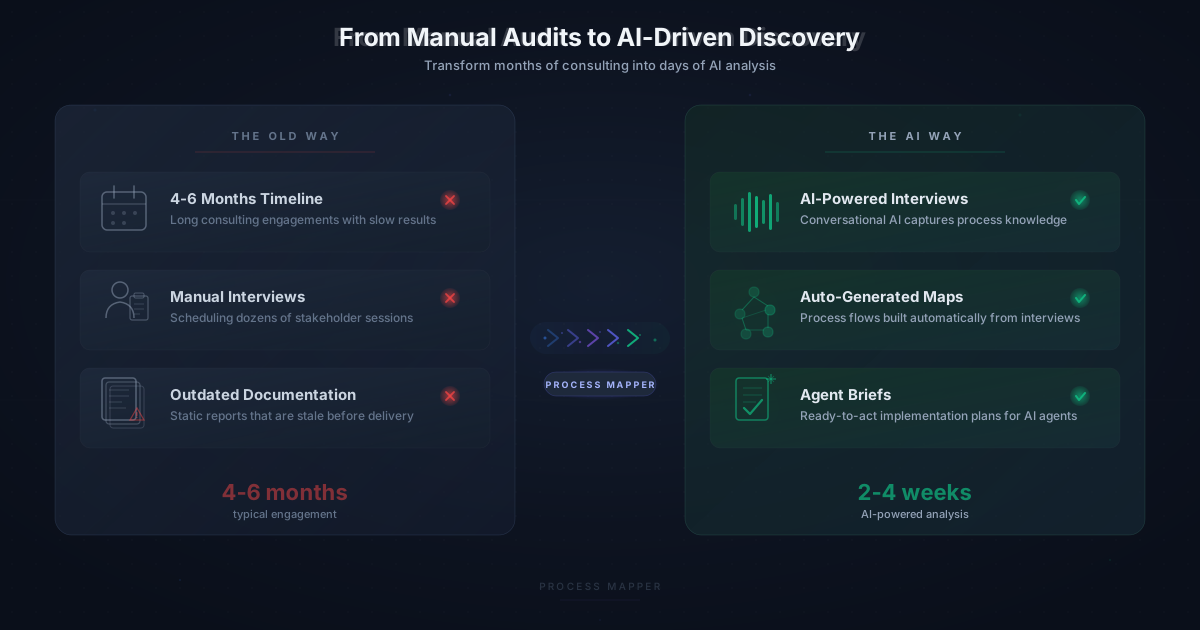
Traditional process audits are expensive, slow, and structurally biased. Consultants spend weeks in conference rooms, synthesizing observations into Visio diagrams that are outdated before the ink dries. The exercise can cost hundreds of thousands of dollars and take months, only to produce a snapshot that begins decaying the moment it is delivered.
AI-driven process discovery replaces the clipboard and the conference room with voice interviews, automated transcription, pattern recognition, and intelligent scoring. It captures how work actually happens, maps it in real time, and identifies the highest-value opportunities for transformation. This guide walks you through the transition.
Why Manual Audits Fall Short
The Documentation Gap
Most organizations maintain process documentation created during an initial implementation or a previous audit cycle. Over time, employees adapt with shortcuts, workarounds, and informal handoff protocols that never reach the official docs. When an auditor asks "how does this process work?" they get the official answer, not the real one. The result is a map of an idealized process that does not exist in practice.
The Time and Cost Burden
A typical audit for a single business function requires scheduling interviews with dozens of stakeholders across multiple time zones. Each interview must be facilitated by a trained consultant, manually documented, and cross-referenced with others. For a mid-size enterprise with ten to fifteen core functions, a comprehensive audit can consume four to six months and cost between two hundred thousand and five hundred thousand dollars, all while chasing a moving target as the organization continues to evolve.
Human Bias in Discovery
Interviewers bring assumptions and ask leading questions. They focus on familiar areas and skim over unfamiliar territory. Stakeholders emphasize what they find most important or most frustrating, which may not align with the areas of greatest organizational impact. The result is a process map shaped by the biases of both parties rather than an objective picture of how work flows.
What AI-Driven Process Discovery Looks Like
Instead of formal workshops, the AI conducts voice interviews with individual stakeholders at their convenience. An intelligent interview engine adapts its questions based on responses, probing deeper into areas of complexity and steering the conversation when it drifts. The interviews feel natural, more like a conversation with a knowledgeable colleague than a formal audit.
Every interview is automatically transcribed and fed into pattern recognition models that identify process steps, decision points, handoffs, exceptions, and pain points. The AI cross-references multiple interviews to build a composite picture that resolves contradictions and highlights discrepancies.
The output is a dynamic, structured process map that captures the actual workflow as described by the people who do the work. Because the AI scores every process step against a consistent analytical framework, the resulting recommendations are free from subjective bias.
Step-by-Step Migration Guide
Transitioning to AI-driven process discovery does not require wholesale organizational change. Start with a single pilot and expand from there.
Step 1: Identify Your First Pilot Project
Choose a single department or business function. The ideal candidate is operationally important but not mission-critical, involves eight to fifteen stakeholders, and has a known gap between documented processes and actual practice.
Good candidates include accounts payable, customer onboarding, order fulfillment, or IT service management. Avoid highly regulated functions like compliance or treasury operations where resistance will be strongest.
Create a new project in Process Mapper, assign it to the relevant team workspace, and define the function scope. This establishes the organizational context the AI will use to guide its interviews.
Step 2: Set Up AI Voice Interviews
Each stakeholder receives a link to an interview session they can complete at their convenience, typically in twenty to thirty minutes. The interview engine generates tailored questions based on your organizational context and function definition, beginning broad and progressively narrowing to specific process steps, decision points, and handoffs.
The AI adapts in real time. If a stakeholder mentions exception handling, the engine probes deeper. If they describe a handoff to another team, it asks about communication channels, latency, and error rates. You can also upload supporting documents like SOPs or org charts so the AI can identify gaps between official documentation and described processes.
Step 3: Review Generated Process Maps
As interviews complete, Process Mapper synthesizes information into structured process maps capturing process steps, decision branches, parallel workflows, exception paths, stakeholder roles, system touchpoints, and timing estimates.
The map view shows the composite process assembled from all interviews, with the ability to drill into individual perspectives. Where stakeholders disagree, the map highlights discrepancies. Review with your core team and look for surprises: hidden steps, unnecessary delays, and inconsistently applied decision criteria. These are where the greatest improvement opportunities lie.
Step 4: Analyze AI Opportunity Scores
Process Mapper assigns AI opportunity scores across multiple dimensions: automation potential, complexity reduction, error rate impact, time savings, and strategic alignment. Each opportunity is scored on a consistent framework, eliminating subjective judgment. High automation and time savings with low complexity signals a quick win. High scores across all dimensions signals a strategic transformation candidate.
The analysis also maps dependencies, identifying which improvements are prerequisites for others so you can sequence your roadmap to build momentum and avoid blockers. Review scored opportunities with leadership and use the scores as an objective starting point for decision-making.
Step 5: Generate Implementation Plans
For each opportunity you pursue, Process Mapper generates agent briefs and recommendations. These are contextualized plans that account for the actual discovered process, the stakeholders involved, the systems in use, and the constraints identified during interviews.
Each brief includes a problem statement drawn from interview data, a proposed solution architecture, implementation timeline, resource requirements, risk factors, and success metrics. It serves as a ready-made project charter your team can execute immediately, without the weeks of additional scoping that follow a manual audit.
Generate briefs for your top three to five opportunities and circulate them for validation. Because they are grounded in stakeholders' own words, they receive much higher buy-in than external consultant recommendations.
Real-World Benefits
Dramatic time savings. Four to six months compresses to two to four weeks. Voice interviews run asynchronously, AI synthesis takes minutes, and the resulting map reflects the current state of the organization rather than a stale snapshot.
Unbiased discovery. The AI asks every stakeholder the same foundational questions and adapts based on responses, not preconceptions. This captures informal processes and workarounds that manual audits routinely miss.
Continuous improvement. Lower cost and faster cycles make it feasible to run discovery quarterly or monthly, transforming process mapping from a periodic event into a continuous capability that detects process drift in near real time.
Higher stakeholder buy-in. Recommendations grounded in stakeholders' own words and supported by objective scoring carry more credibility than consultant opinions. Teams spend less time justifying plans and more time executing them.
Getting Started
Start by identifying one business function where documented processes do not match reality. Set up a project in Process Mapper, run voice interviews with key stakeholders, and compare the AI-generated maps against your existing documentation. The gaps you discover will make the case more persuasively than any vendor pitch.
Process Mapper gives enterprise teams the tools to understand how work actually happens, identify the highest-impact opportunities for AI transformation, and generate actionable implementation plans, all in a fraction of the time and cost of traditional approaches.