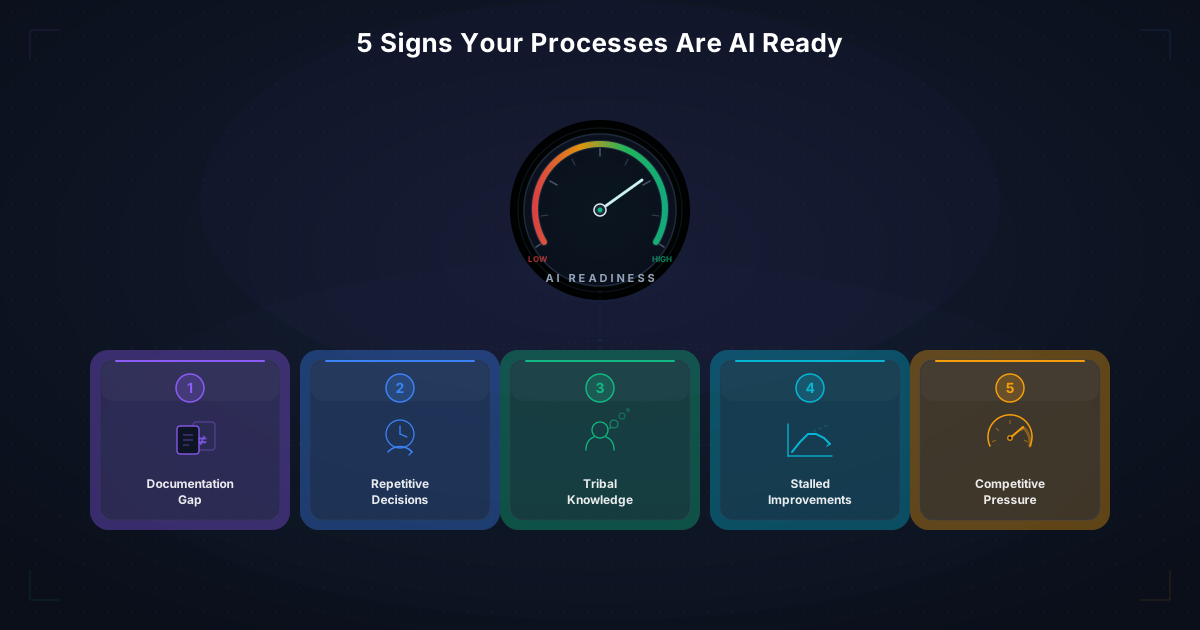
Every enterprise leader has heard the pitch: AI will revolutionize your operations. Yet for every successful AI deployment, dozens stall in pilot purgatory or quietly get shelved. The difference rarely comes down to technology. It comes down to whether the processes being targeted were actually ready for transformation.
Most organizations pick the wrong processes first, chasing the flashiest use case rather than the one that will deliver measurable returns. We have identified five reliable signals that a process is practically begging for AI transformation.
If you recognize three or more of these signs, you are sitting on significant untapped value.
Sign #1: Your Teams Describe Processes Differently Than Documentation Shows
Ask three people in the same department to walk you through a core workflow, and you will get three different answers. Pull up the official documentation, and you will find a fourth version that matches none of them.
This gap between "as documented" and "as practiced" is not a failure of discipline. It means your teams have been silently optimizing around friction points, inventing workarounds, and accumulating practical knowledge that never made it into the official record.
Why this matters for AI: AI transformation starts with process discovery, and the real process is the one people actually follow. When you find a significant gap between documentation and reality, structured discovery will yield immediate insights. Mapping what actually happens almost always reveals redundancies, bottlenecks, and decision points ripe for intelligent automation.
What to look for: Conflicting descriptions of the same workflow. Documentation untouched for over a year. Frequent use of "well, technically the process says X, but what we actually do is..." These are not problems to fix before AI. They are the reasons AI will deliver outsized value.
Sign #2: You're Spending More Than 20% of Team Time on Repetitive Decisions
There is a category of work that looks like judgment but is actually pattern matching. An experienced claims adjuster processing a straightforward claim in ninety seconds is not exercising deep expertise each time. They are running an internalized decision tree. A procurement specialist routing purchase orders is applying rules, not strategy.
When skilled professionals spend more than a fifth of their hours on these high-volume, rule-based decisions, you are paying for expertise you are not using and burning out your best people on work that does not challenge them.
Why this matters for AI: Repetitive decision-making is the sweet spot for AI augmentation. A well-implemented AI system can process the eighty percent of cases that follow established patterns, flagging only the twenty percent that genuinely need human review.
The 20% threshold: Below twenty percent, implementation costs often exceed labor savings within a reasonable payback period. Above it, ROI becomes compelling quickly, typically showing positive returns within six to twelve months. Track how your team spends time for two weeks. Categorize each task as "applying established rules" or "exercising genuine judgment on novel situations." The ratio will tell you whether you have crossed the threshold.
Sign #3: Your Process Knowledge Lives in People's Heads
Every organization has them: the person who knows which supplier to call when the usual one falls through, the analyst who remembers why an exception was built into the approval workflow eight years ago, the manager who can navigate an unwritten escalation path.
This tribal knowledge is simultaneously your greatest asset and most critical vulnerability. When these individuals leave, entire capabilities walk out the door. Succession documents capture job responsibilities but rarely the hundreds of micro-decisions that make someone effective in a role.
Why this matters for AI: AI transformation requires externalizing tacit knowledge through structured interviews, decision-logic mapping, and documenting the "why" behind practices. That externalized knowledge becomes the training data and rule set that makes AI effective. Organizations that have already lost critical tribal knowledge to attrition often find AI projects stall because no one can articulate the rules the system needs to follow.
The risk calculation: If any of your most process-critical team members left tomorrow, how long would it take to restore full capability? If the answer is months rather than days, your processes urgently need AI transformation as a knowledge preservation strategy.
Sign #4: You've Tried Process Improvement Before But Changes Didn't Stick
If you have invested in Lean, Six Sigma, or business process reengineering and found that performance gains eroded within six to eighteen months, you do not have a methodology problem. You have a sustainability problem.
Traditional process improvement relies on human compliance. You redesign a workflow, train people, and hope inertia does not pull everyone back. But inertia almost always wins. People revert under pressure. New employees learn the informal process from colleagues. Edge cases accumulate workarounds that become the de facto standard.
Why this matters for AI: AI does not suffer from organizational inertia. Once configured to route decisions, flag exceptions, or enforce process steps, it does so consistently. It does not revert to old habits during a busy quarter or forget the new procedure after the consultant leaves. This is not about replacing human flexibility with rigid automation. It is about using AI as a process backbone that maintains consistency while humans handle situations requiring adaptive thinking.
The pattern to watch for: Measure current performance against your last three improvement initiatives. If you are hitting less than sixty percent of original goals, those processes are strong candidates for AI-augmented transformation.
Sign #5: Your Competitors Are Already Doing It
In industry after industry, the window for AI transformation as a competitive differentiator is closing. What was a first-mover advantage two years ago is becoming table stakes. If your competitors are deploying AI-augmented operations while you are still evaluating vendors, the gap is accelerating.
Organizations that deploy AI into well-chosen processes typically see fifteen to forty percent efficiency gains within the first year. Those gains compound as the system learns from more data and the organization builds capability for additional use cases. A competitor that started twelve months before you has both a head start and a compound learning advantage.
How to assess this: Monitor your top five competitors for AI-related announcements, hires, and partnerships. Talk to customers about what they see from alternative providers. If the performance bar is moving faster than your improvement trajectory can match, the market is telling you something you should not ignore.
How to Score Your Opportunities
Recognizing these signs is the first step. The second is prioritizing which processes to transform first, because sequencing matters enormously.
At Process Mapper, we use a three-tier scoring framework evaluating feasibility, impact, and strategic alignment:
Quick Wins have high feasibility and moderate impact. The rules are clear, data is accessible, and deployment takes weeks rather than months. They build organizational confidence and generate early ROI that funds larger initiatives.
Strategic Plays have moderate feasibility but high impact. They require more investment in discovery and change management but target processes central to competitive positioning, with six to twelve month timelines delivering transformative improvements.
Moon Shots have lower near-term feasibility but game-changing potential. They belong on your roadmap but not at the top of your execution queue.
Most organizations gravitate toward Moon Shots because they are the most exciting. But those that start with Quick Wins and build toward Strategic Plays have dramatically higher success rates.
Your Next Step
If you recognized your organization in three or more of these signs, you are leaving value on the table by waiting.
Process Mapper helps enterprise teams move from recognition to action. Our AI-guided discovery process maps your actual workflows, identifies the highest-value opportunities, and scores them so you know exactly where to start.
The organizations that thrive in the next decade will not be the ones with the most advanced AI. They will be the ones that chose the right processes to transform first.
Start mapping your opportunities today with Process Mapper.